Java Abstract classes are used to declare common
characteristics of subclasses. An abstract class cannot be instantiated.
It can only be used as a super class for other classes that extend the
abstract class. Abstract classes are declared with the abstract keyword.
Abstract classes are used to provide a template or design for concrete
subclasses down the inheritance tree.
Like any other class, an abstract class can contain fields that describe the characteristics and methods that describe the actions that a class can perform. An abstract class can include methods that contain no implementation. These are called abstract methods. The abstract method declaration must then end with a semicolon rather than a block. If a class has any abstract methods, whether declared or inherited, the entire class must be declared abstract. Abstract methods are used to provide a template for the classes that inherit the abstract methods.
Abstract classes cannot be instantiated; they must be subclassed, and actual implementations must be provided for the abstract methods. Any implementation specified can, of course, be overridden by additional subclasses. An object must have an implementation for all of its methods. You need to create a subclass that provides an implementation for the abstract method.
A class abstract Vehicle might be specified as abstract to represent the general abstraction of a vehicle, as creating instances of the class would not be meaningful.
You can require that certain methods be overridden by subclasses by specifying the abstract type modifier. These methods are sometimes referred to as subclasser responsibility because they have no implementation specified in the superclass. Thus, a subclass must override them—it cannot simply use the version defined in the superclass. To declare an abstract method, use this general form:
As you can see, no method body is present. Any class that contains one or more abstract methods must also be declared abstract. To declare a class abstract, you simply use the abstract keyword in front of the class keyword at the beginning of the class declaration. There can be no objects of an abstract class. That is, an abstract class cannot be directly instantiated with the new operator. Such objects would be useless, because an abstract class is not fully defined. Also, you cannot declare abstract constructors, or abstract static methods. Any subclass of an abstract class must either implement all of the abstract methods in the superclass, or be itself declared abstract. Here is a simple example of a class with an abstract method, followed by a class which implements that method:
Program AbstractDemo.java
abstract class Shape
{
abstract void draw();
}
class Rectangle extends Shape
{
void draw()
{
System.out.println("Drawing Rectangle");
}
}
class Traingle extends Shape
{
void draw()
{
System.out.println("Drawing Traingle");
}
}
class AbstractDemo
{
public static void main(String args[])
{
Shape s1=new Rectangle();
s1.draw();
s1=new Traingle();
s1.draw();
}
}
G:\>javac AbstractDemo.java
G:\>java AbstractDemo
Drawing Rectangle
Drawing Traingle
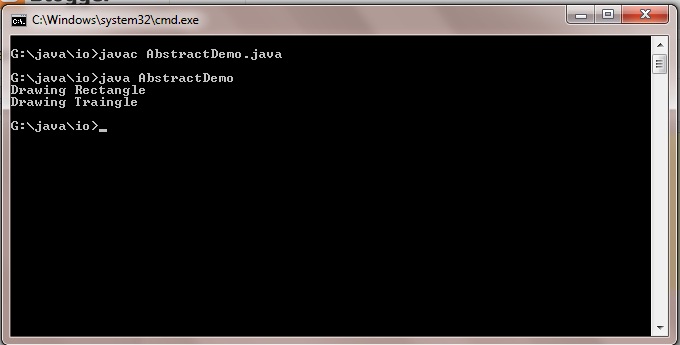
The subclass must define an implementation for every abstract method of the abstract superclass, or the subclass itself will also be abstract. Similarly other shape objects can be created using the generic Shape Abstract class.
A big Disadvantage of using abstract classes is not able to use multiple inheritance. In the sense, when a class extends an abstract class, it can’t extend any other class.
Like any other class, an abstract class can contain fields that describe the characteristics and methods that describe the actions that a class can perform. An abstract class can include methods that contain no implementation. These are called abstract methods. The abstract method declaration must then end with a semicolon rather than a block. If a class has any abstract methods, whether declared or inherited, the entire class must be declared abstract. Abstract methods are used to provide a template for the classes that inherit the abstract methods.
Abstract classes cannot be instantiated; they must be subclassed, and actual implementations must be provided for the abstract methods. Any implementation specified can, of course, be overridden by additional subclasses. An object must have an implementation for all of its methods. You need to create a subclass that provides an implementation for the abstract method.
A class abstract Vehicle might be specified as abstract to represent the general abstraction of a vehicle, as creating instances of the class would not be meaningful.
You can require that certain methods be overridden by subclasses by specifying the abstract type modifier. These methods are sometimes referred to as subclasser responsibility because they have no implementation specified in the superclass. Thus, a subclass must override them—it cannot simply use the version defined in the superclass. To declare an abstract method, use this general form:
abstract type name(parameter-list);
As you can see, no method body is present. Any class that contains one or more abstract methods must also be declared abstract. To declare a class abstract, you simply use the abstract keyword in front of the class keyword at the beginning of the class declaration. There can be no objects of an abstract class. That is, an abstract class cannot be directly instantiated with the new operator. Such objects would be useless, because an abstract class is not fully defined. Also, you cannot declare abstract constructors, or abstract static methods. Any subclass of an abstract class must either implement all of the abstract methods in the superclass, or be itself declared abstract. Here is a simple example of a class with an abstract method, followed by a class which implements that method:
Program AbstractDemo.java
abstract class Shape
{
abstract void draw();
}
class Rectangle extends Shape
{
void draw()
{
System.out.println("Drawing Rectangle");
}
}
class Traingle extends Shape
{
void draw()
{
System.out.println("Drawing Traingle");
}
}
class AbstractDemo
{
public static void main(String args[])
{
Shape s1=new Rectangle();
s1.draw();
s1=new Traingle();
s1.draw();
}
}
Output
G:\>javac AbstractDemo.java
G:\>java AbstractDemo
Drawing Rectangle
Drawing Traingle
The subclass must define an implementation for every abstract method of the abstract superclass, or the subclass itself will also be abstract. Similarly other shape objects can be created using the generic Shape Abstract class.
A big Disadvantage of using abstract classes is not able to use multiple inheritance. In the sense, when a class extends an abstract class, it can’t extend any other class.
